24 Greatest Ken Griffey Jr. Cards of All-Time
Trends come and go. Some are timeless. Ken Griffey Jr. cards have been in style since he broke into the majors in 1989.
A true generational talent, Griffey’s popularity transcended the sport. His smile, highlight reel players and youthful personality made him a household name, even in ones where sports stayed on the back pages of the newspaper.
When it comes to collecting, Griffey’s time in the league charts the peak of the great 1980s and early ’90s boom as well as the innovation that came in the years that followed. His cardboard career is like a hobby history lesson. While Griffey set trends, he’s also a symbol of others.
It has been well over a decade since his final game and Griffey still ranks among the most popular. Not surprisingly, collectors have to choose from. The Kid has appeared on more than 25,000 cards since his minor league debut in 1987. They come at all price points ranging from under a dollar to tens of thousands.
Top 24 Ken Griffey Jr. Cards
Here’s a list of the best and most important Ken Griffey Jr. cards ever produced. It’s not necessarily his most valuable cards, although that is a big consideration. Some are very affordable even today but are notable for what they represent, either for Griffey as a player or his place in hobby history.
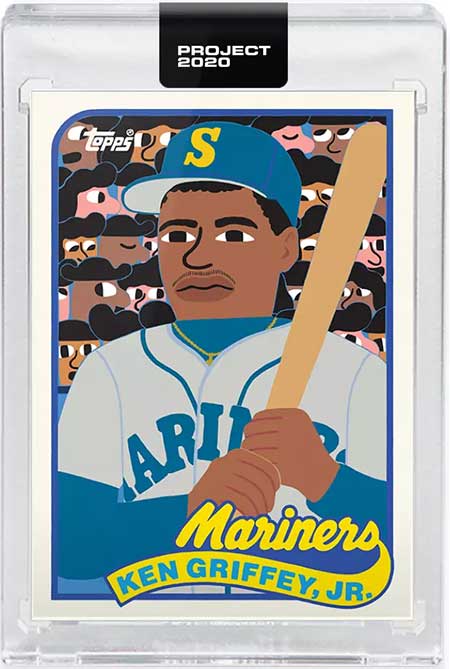
24. 2020 Topps Project 2020 #88
Seriously. If you’re looking for a single baseball card to symbolize the COVID boom, this is it. While Project 2020 started out mildly like a lot of Topps’ online-exclusives, speculation soon kicked in and some of the early cards were selling for hundreds before they even shipped out from the card maker. It was a wild few weeks of people thinking they could get rich off a couple of clicks. Keith Shore’s rendition of The Kid a whopping 99,177 copies. Safe to say that the only people who got rich off the card were Topps and whoever sold them the one-touch holders they were sent in.
Buy on:
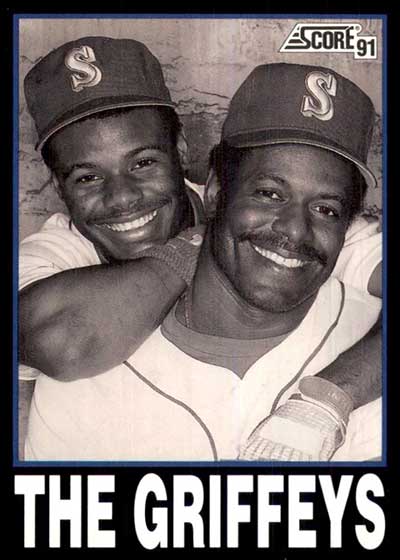
23. 1991 Score #841 The Griffeys
Great cards can be cheap cards. One of the lasting highlights of Griffey’s career came early when he got to play alongside his dad in 1990 and 1991. 1991 Score Series 2 includes a portrait-style card that captures the special achievement. Sure, it can be found for under a dollar but it’s still a classic. It is worth noting the this isn’t the first card to feature the father-son combo. 1989 Bowman has one as well. However, that one doesn’t have the same connection to the game, or even the same team.
Buy on:
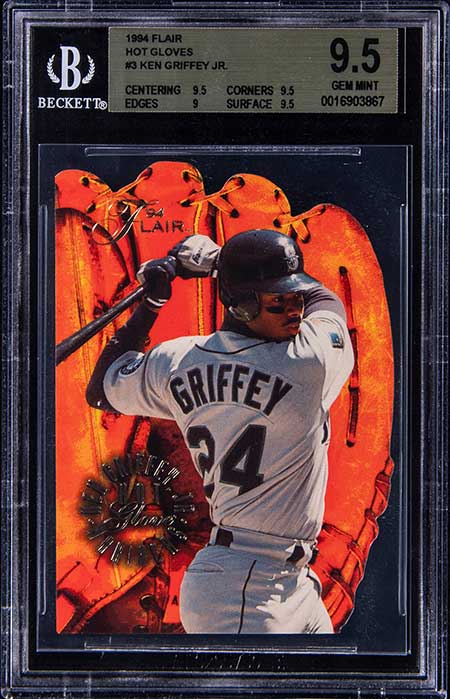
22. 1994 Flair Hot Gloves #3
There’s a reason why home run hitters and offensive threats get a lot of attention when it comes to insert themes. Save for the rare leaping snag or infield acrobatics, defense isn’t all that exciting. So how do you make a set celebrating baseball’s best in the field? You make the cards look like gloves. Before 1994 Flair Hot Gloves, die-cut designs were still pretty plain with maybe a curved edge. Here, things get a lot more intricate. The result is one of the most attractive and influential chase sets of the early ’90s. Landing one per Series 2 box, Griffey headlines the strong 10-card set.
Buy on:
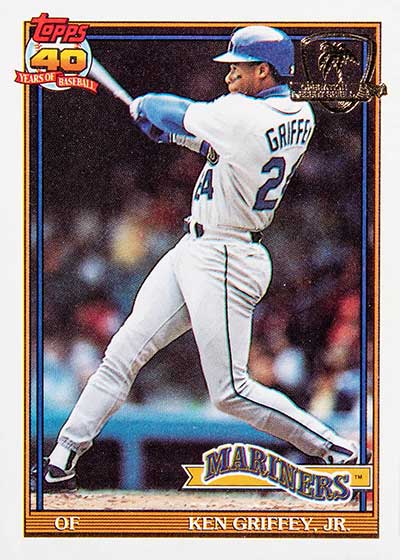
21. 1991 Topps Desert Shield #790
When it comes to photos, 1991 Topps has one of the best shots he ever had in his flagship run. While that’s nice and all, it doesn’t make for one of the truly iconic Ken Griffey Jr. cards. But the story behind this version does. When the Gulf War entered its first phase, Topps produced a special run of cards to send to American troops. This not only gives them a story but it connects them with a time in history. 1991 Topps Desert Shield Baseball cards are just like the originals except for a small foil stamp. Rarity comes into play as well with so many collectors having fond memories of the early 1990s but not many options when it comes to truly rare sets.
Buy on:
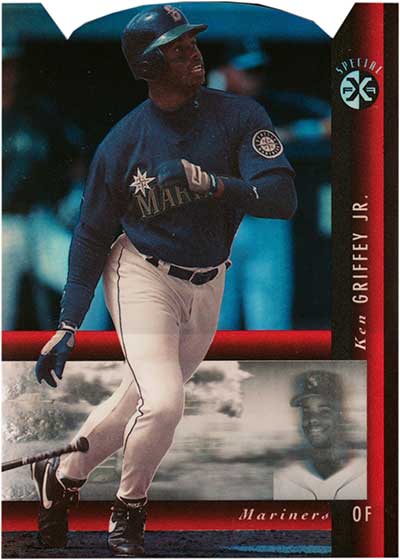
20. 1994 SP Holoviews Die-Cuts #12
In the early ’90s, holograms were the high point of sports card technology. With the hobby definition of premium quickly evolving, SP became Upper Deck’s high point in that regard and Holoviews Die-Cuts were the chase. The tough cards land 1:75 packs with Griffey sitting behind a White Sox minor leaguer named Michael Jordan as the most valuable card in the set.
Buy on:
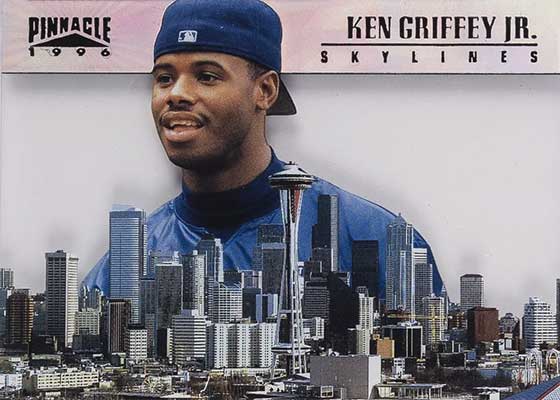
19. 1996 Pinnacle Skylines #1
One of the standout insert sets of the decade, 1996 Pinnacle Skylines is one of the hobby’s early acetate sets. So there’s a technology angle, even if it’s a fairly common one today. Then there’s the theme. Griffey and the other 17 players in the set are cast as giants making their presence known, looming over their respective team’s cityscapes. At 1:29 Series 2 magazine packs, the odds might not seem too tough. But this one is elusive. Magazine packs aren’t nearly as common as hobby or standard retail. Plus, when cards are as cool as these, they tend to end up in many permanent collections, making an already limited supply that much tougher to track down.
Buy on:
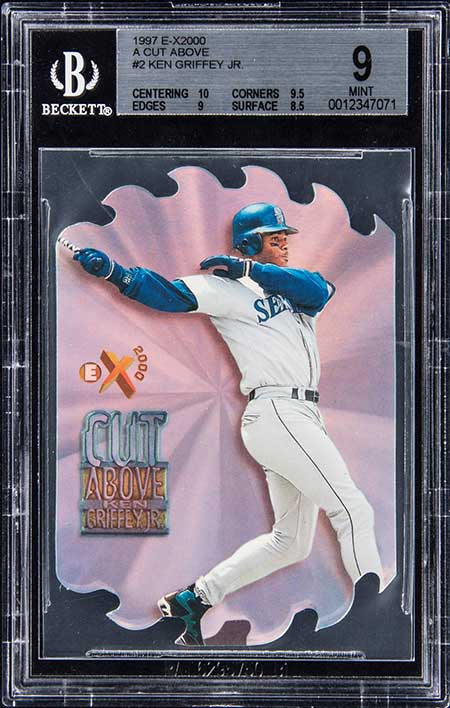
18. 1997 E-X2000 A Cut Above #2
Imagine collecting Mantle and Mays in the 1950s and ’60s and 25 years later there were cards shaped like saw blades. The 1997 E-X2000 A Cut Above Ken Griffey Jr. is one of his rarest late ’90s inserts, landing 1:288 packs. E-X2000 was also one of the most expensive products on the market at the time, originally running $5 for a pack of just two cards. The scarcity and standout design have ensured that this remains one of the best Ken Griffey Jr. cards ever made.
Buy on:
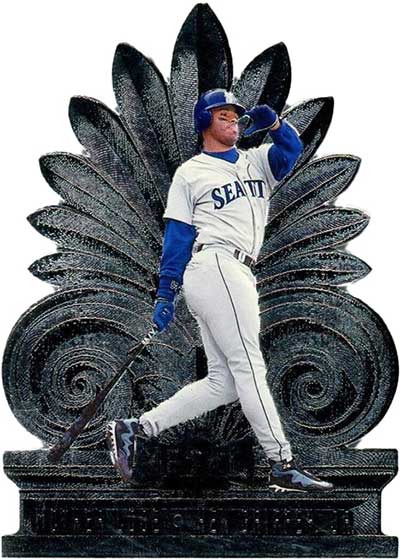
17. 1997 Metal Universe Mother Lode #4
It’s not a saw blade, but the 1997 Metal Universe Mother Lode Ken Griffey Jr. certainly stands out, in large part due to its die-cut shape. It’s also done with etched foil giving it a lot of pop. But simply being a great looking Ken Griffey Jr. card doesn’t make it one of the greatest. It’s an extremely tough one as well, falling 1:288 packs. As Metal Universe’s popularity has soared in recent years, it’s the cherry that has pushed this one to further heights.
Buy on:
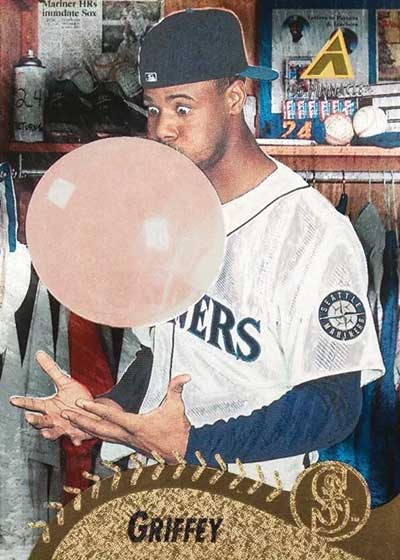
16. 1995 Pinnacle Museum Collection #128
Sometimes a baseball card can stand out simply for being fun. Junior’s baseball card catalog has lots that prove this but none more so than 1995 Pinnacle. The massive bubble, the look of astonishment, the trademark backwards hat, even the treasure trove in his locker all go together to capture the pure joy of The Kid. While the base card is great, the Dufex Museum Collection parallel is even better. It adds that rarity aspect not to mention the gorgeous foil flash that’s a hallmark of mid ’90s Pinnacle.
Buy on:
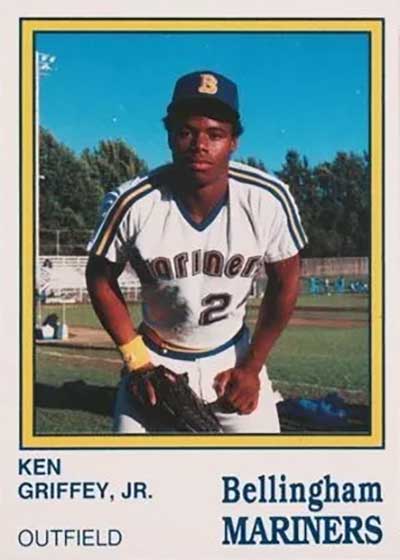
15. 1987 Bellingham Mariners #15
His 1989 Rookie Cards weren’t the first Ken Griffey Jr. cards. That distinction actually came a couple of years prior with the release of the Single-A Bellingham Mariners team set. With a print run of 15,000 sets, it’s not overly rare but the card’s importance is big in the greater Griffey picture.
Buy on:
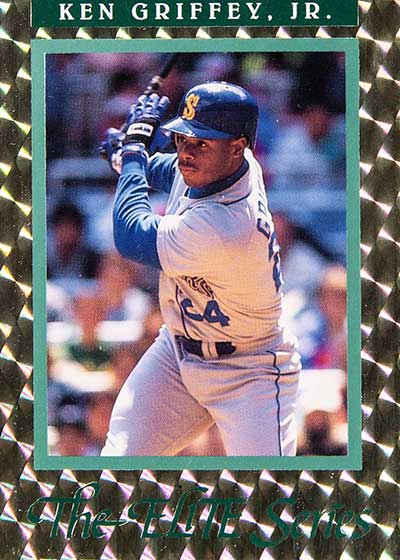
14. 1992 Donruss Elite #13 /10000
When it comes to innovation and importance, 1992 Donruss Elite inserts aren’t as memorable as the set’s debut the previous year. But Griffey doesn’t have a 1991 Elite insert. He’s the top card in 1992, which is both gorgeous and considered scarce for the time with a numbered production run of only 10,000 copies.
Buy on:
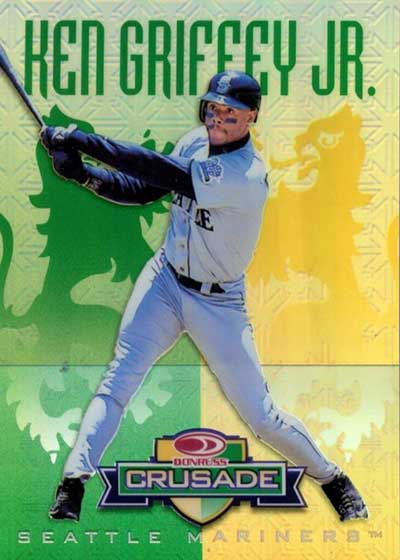
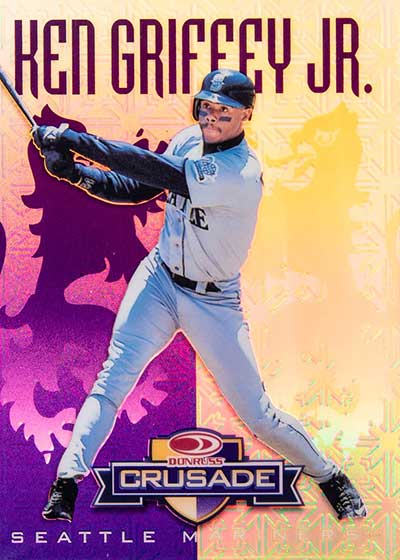
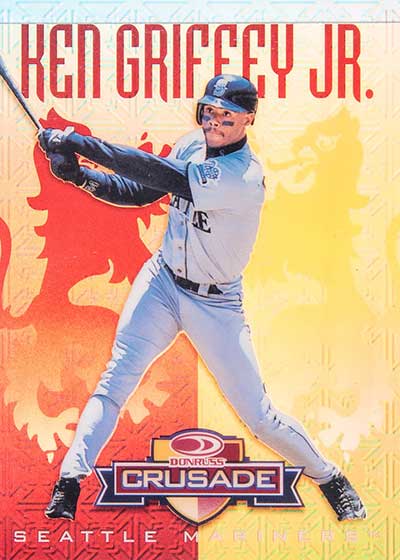
13. 1998 Donruss Crusade #39
For many, the late 1990s were a golden age for inserts. They were colorful and often innovative in a variety of ways. Embracing design, rarity and intrigue, 1998 Donruss Crusade remains a favorite decades later. Landing in a handful of Donruss/Leaf products that year, standard Crusade cards all come numbered. Green are the most common at 250 copies each. Things drop off from there to 100 for Purple and just 25 for Red. The Griffey was found in 1998 Donruss Series 1 packs and it remains one of his most hunted cards today.
Buy on:
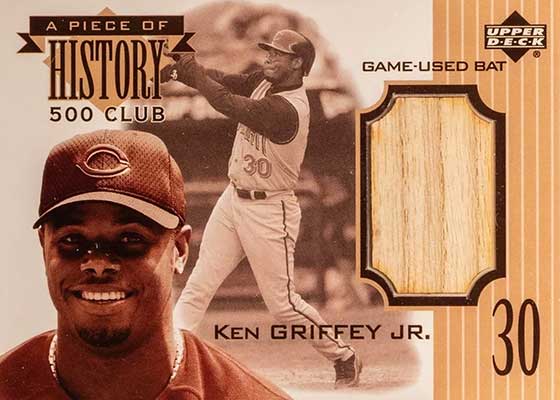
12. 2004 Upper Deck Etchings Piece of History 500 Club #KG
Griffey joined baseball’s prestigious 500 Home Run Club on June 20, 2004, Father’s Day. That also made him eligible for one of the most impressive memorabilia sets the hobby has seen, especially at that point. Upper Deck spread Piece of History 500 Club cards throughout several products and several seasons starting in 1999 with players like Babe Ruth, Hank Aaron, Willie Mays and Mickey Mantle. The Kid joined the set in 2004 Upper Deck Etchings, using the same design as the ones that came before him. The base version has 350 copies while an autograph is numbered to just 25.
Buy on:
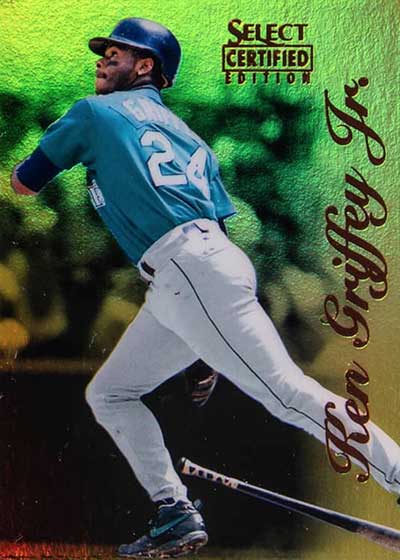
11. 1996 Select Certified Mirror Gold #47
One of the main themes of mid- to late-1990s baseball cards is shrinking production numbers. 1991 Donruss Elite brought serial-numbered cards to the mainstream with 10,000 cards. From there, it was a race to the bottom with collectors clamoring for lower numbers. Fast forward five years and 1996 Select Mirror Gold came in with a stated print run of just 30 copies. This Griffey is seldom seen today and stands out even with several other sets from the era with similar rarity.
Buy on:
10. 1998 Metal Universe Precious Metal Gems #161 /50
Although not quite as big in baseball as they are in basketball, Precious Metal Gems rank as some of the most popular modern cards of all-time. And just because they don’t have quite the same status, that doesn’t mean that Griffey’s first PMG isn’t valuable. It is. A BGS 8 copy sold for $54,000 in March, 2023 through Goldin. Numbered to 50, it’s an elusive card. The already wild base design that pits Griffey in front of a mountain peak is made even bolder with the scope backdrop. When it comes to Junior parallels, this is definitely among the best of the best when it comes to the most valuable.
Buy on:
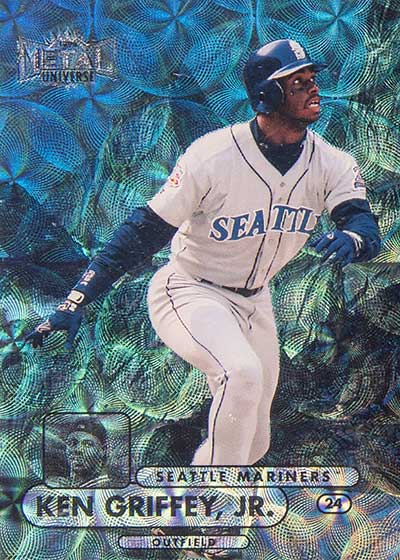
9. 1993 Finest Refractors #110
According the the Beckett database, there are nearly 900 different Ken Griffey Jr. cards that are Refractors. Out of all of them, the first is arguably the most important. 1993 Finest Baseball burst onto the scene as the first set of mainstream chromium sports cards. The technology was the product’s anchor but there was also the Refractor parallels that not only added some bright pop but a rare chase element as well. It’s estimated that just 241 copies of the card exist, so rarity is a factor. Perhaps even bigger is that it helped launch one of the most influential types of cards in the modern hobby. It’s hard to imagine what collecting would look like today if 1993 Finest and all the other chrome sets that followed never happened.
Buy on:
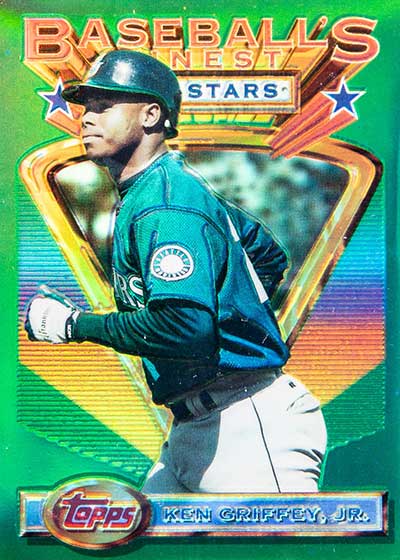
8. 1998 SP Authentic Chirography #KG
Despite hundreds to choose from over the years, this stands out as a centerpiece Ken Griffey Jr. autograph card. The sleek design, flawless penmanship, hero angle and stellar backwards hat shot make this one of the centerfielder’s very best. At 400 copies, rarity comes into play somewhat but like 1995 Pinnacle, the photo helps it really stand out and even command a premium over similar cards.
Buy on:
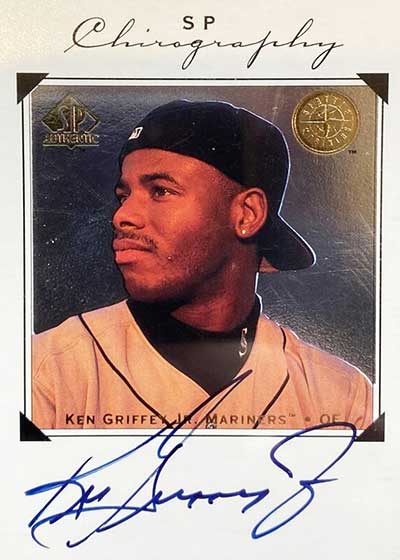
7. 1999 Upper Deck Game Jersey Autograph /24
Griffey has a pair of autographed memorabilia cards in 1999 Upper Deck Baseball. Both are ultra scarce, hand-numbered to just 24 copies. While the first ballot Hall of Famer has plenty of signed relics now, these were among the earliest. The design is one also considered one of the most iconic for a memorabilia set.
Buy on:
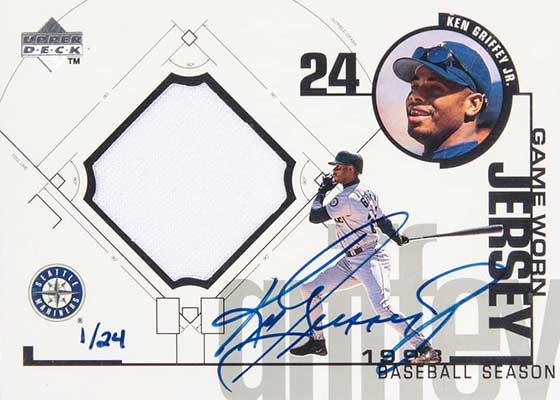
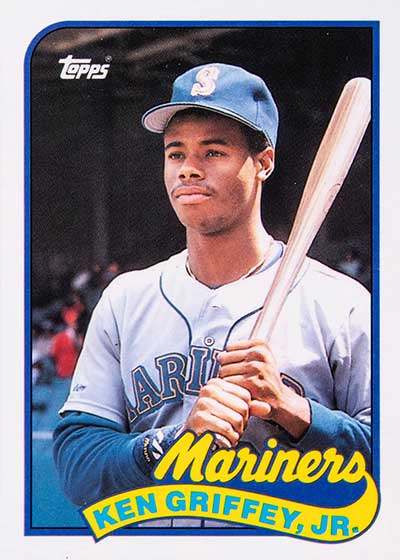
6. 1989 Topps Traded Tiffany #41T
Arguably, the 1989 Topps Traded Ken Griffey Jr. has emerged as his second most recognizable Rookie Card. But let’s face it, there are a ton of them out there. For those looking for something tougher, there’s the Tiffany option. Essentially a parallel that was sold exclusively as a limited edition box set, the card has a premium feel thanks to its glossy finish. The real draw is the print run. With just 15,000 sets produced, the number sounds big by today’s standards but that was just a small fraction of the regular version. The result is a beautiful upgrade of a classic Kid.
Buy on:
5. 1997 Flair Showcase Masterpieces 1/1 #24
Over the years, there are lots of Ken Griffey Jr. cards that are one-of-ones. But none have quite the level of intrigue or importance as the three different 1997 Flair Showcase Masterpieces. That’s because this set is credited as being the first true one-of-ones numbered as such. While bounties on new releases have become a regular occurrence in the internet age, things were a lot different in 1997. Still, word got out that collectors were willing to spend five figures for the Row 0, Row 1 and Row 2 Griffey Masterpieces, something unheard of for modern cards at the time. The cards’ whereabouts are unknown today, likely locked away as the grails that they truly are.
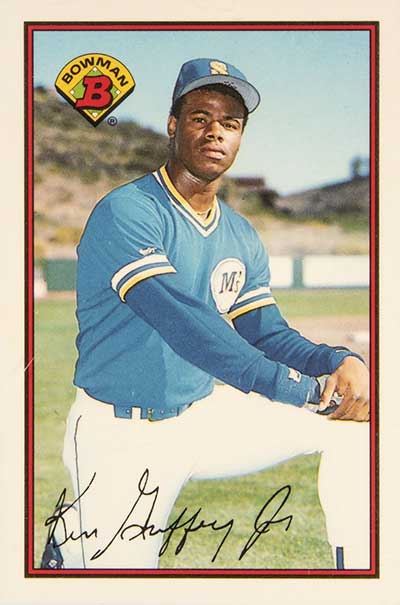
4. 1989 Bowman Tiffany #220
Line up the mainstream Ken Griffey Jr. RCs and 1989 Bowman is likely to rank among the least popular with the larger size and bland design being the biggest strikes against it. But put a little gloss on the front, pack it in a special factory set and give it a minuscule print run and you’ve got a card that’s all of a sudden at or near the top of a lot of Griffey want lists. The estimated 6,000 sets are significantly less than half that of the already low 1989 Topps Traded Tiffany. So even though it’s still not an attractive card, this is a very attractive card in other ways.
Buy on:
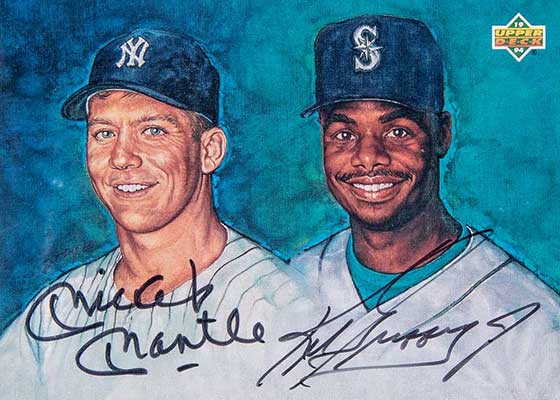
3. 1994 Upper Deck Ken Griffey Jr. / Mickey Mantle Autograph
Junior made a splash with his first certified MLB autograph cards. Included in 1994 Upper Deck Series 1 Baseball, it’s a painted card where he appears alongside Mickey Mantle. Each legend has 1,000 single-signed cards. Another 1,000 came with autographs from both. Needless to say, the solo Griffey autographs are valuable but it’s next level for the dual. Today, it regularly tops $10,000 when they come up for sale. In January, 2022, a BGS 9.5 copy sold for $57,600 through Goldin.
Buy on:
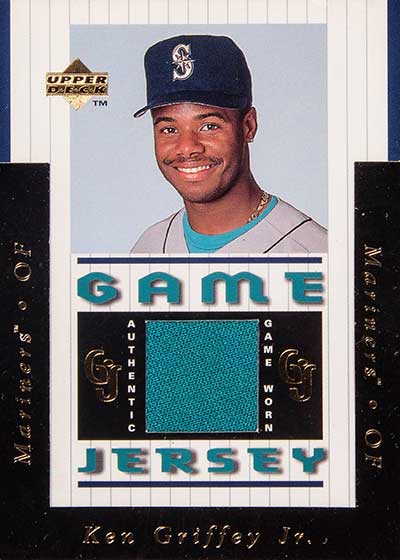
2. 1997 Upper Deck Game Jersey #GJ1
Often when the term “game-changer” is tossed around, it’s hype. When it comes to the 1997 Upper Deck Game Jersey Ken Griffey Jr., it really was a game-changer. Part of the first series of baseball memorabilia cards, it helped launch one of the biggest hobby innovations ever. Plain jersey cards aren’t very exciting today, but that’s largely because they have become so common. This one is anything but. 1997 Upper Deck Game Jersey cards are 1:800 Series 1 packs. With three cards in the set, that’s 1:2,400 packs to land Junior (assuming all were printed in equal numbers).
Buy on:
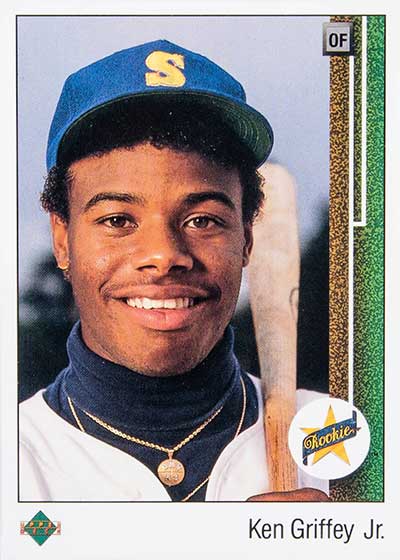
1. 1989 Upper Deck RC #1
One could argue that this is the defining card of a generation. Value aside, it ranks up there with the T206 Honus Wagner and 1952 Topps Mickey Mantle when it comes to iconic baseball cards. Not only that, but it helped launch a new company, one that would transform what mainstream sports card could be and how we collect.
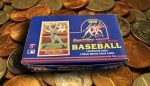
Decades later, you can see people still get excited to rip open those foil 1989 Upper Deck packs hoping for a copy of the card that is so engrained in hobby lore you could simply call it The Griffey and people would know exactly what you’re talking about.
Buy on:



Great article – I need all these- But- We cannot leave the 1996 Hitting Machine card out- has to be top 5